Leather Safe Enzyme Cleaner for Industrial Bating — Supplier Guide
Choose leather enzymes for controlled bating and wet-end trials with pH, temperature, dosage, QC, COA/TDS/SDS, and cost-in-use guidance.
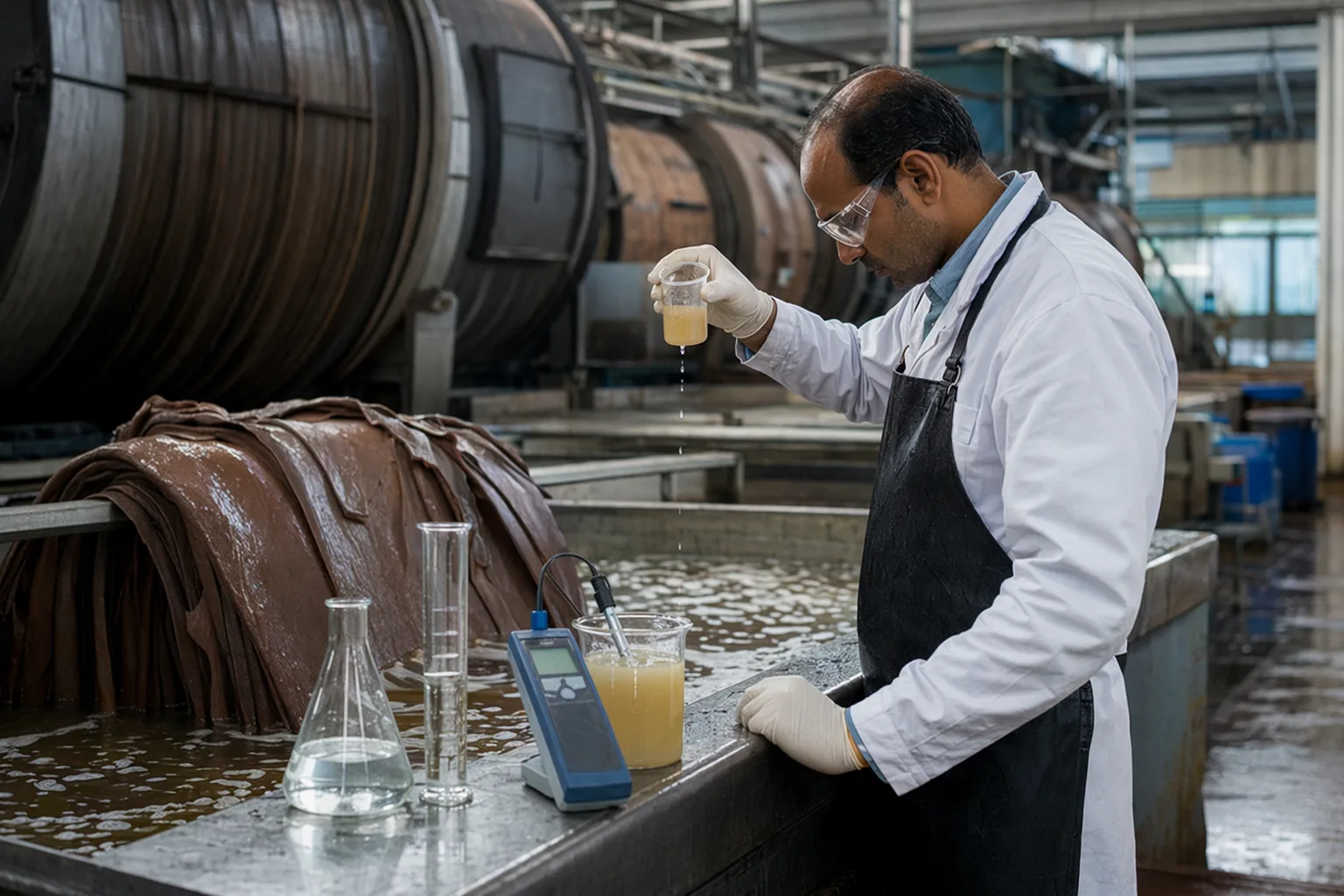
A practical guide for tanneries and formulators selecting leather processing enzymes for safer, repeatable bating, dehairing support, and wet-end quality control.
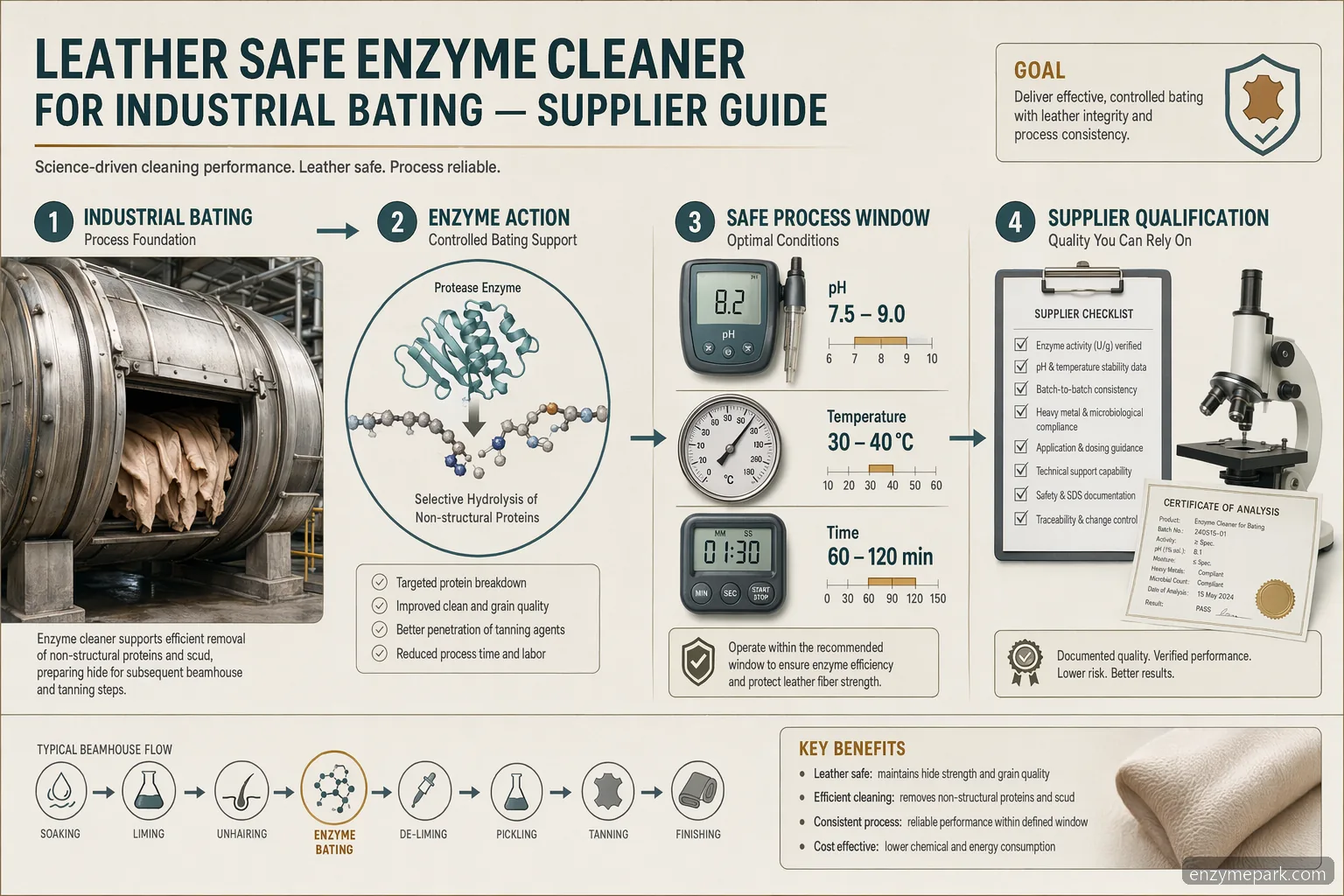
What “Leather Safe Enzyme Cleaner” Means in a Tannery
For B2B leather production, the term leather safe enzyme cleaner should be interpreted as a leather processing enzyme used to remove non-structural proteins and improve opening-up before tanning. It is different from a consumer enzyme cleaner for leather couch care, an enzyme cleaner for leather car seats, or a leather safe enzyme cleaner for cat pee. Finished leather articles can be sensitive to water, surfactants, alkalinity, solvents, and proteases, so household use should follow the article manufacturer’s care guidance. In a tannery, however, controlled enzyme bating is applied to limed or delimed hides under monitored pH, temperature, time, and mechanical action. The objective is to improve softness, grain smoothness, fullness, and uniform dyeing while avoiding excessive collagen attack. Selecting an enzyme cleaner safe for leather therefore requires process data, not a generic cleaning claim.
Industrial application: leather bating and wet-end preparation • Key enzyme class: primarily protease, sometimes blended with auxiliary enzymes • Main risk to control: over-bating, looseness, grain damage, or strength loss
Recommended Bating Process Window
Most bating enzyme programs begin after liming, fleshing, splitting, and deliming, when pH has been reduced to a range suitable for enzyme activity. A common starting window is pH 7.5–9.0 at 30–40 °C for 30–90 minutes, depending on hide thickness, desired softness, enzyme activity, and drum action. Dosage often starts around 0.05–0.50% on pelt weight for concentrated products, but the correct band must be confirmed from the TDS and pilot trials. For a leather safe enzyme cleaner, gradual addition and good float circulation help avoid local overconcentration. Trials should compare control lots against one or more enzyme dosages, using the same deliming endpoint and float ratio. When moving from laboratory to drum scale, confirm that heating rate, drum speed, float length, and pH drift remain within the validated process envelope.
Starting pH: typically 7.5–9.0 for many protease bates • Starting temperature: commonly 30–40 °C • Initial trial dosage: follow TDS, often screened across low, medium, and high levels • Trial time: commonly 30–90 minutes, adjusted by substrate and target handle
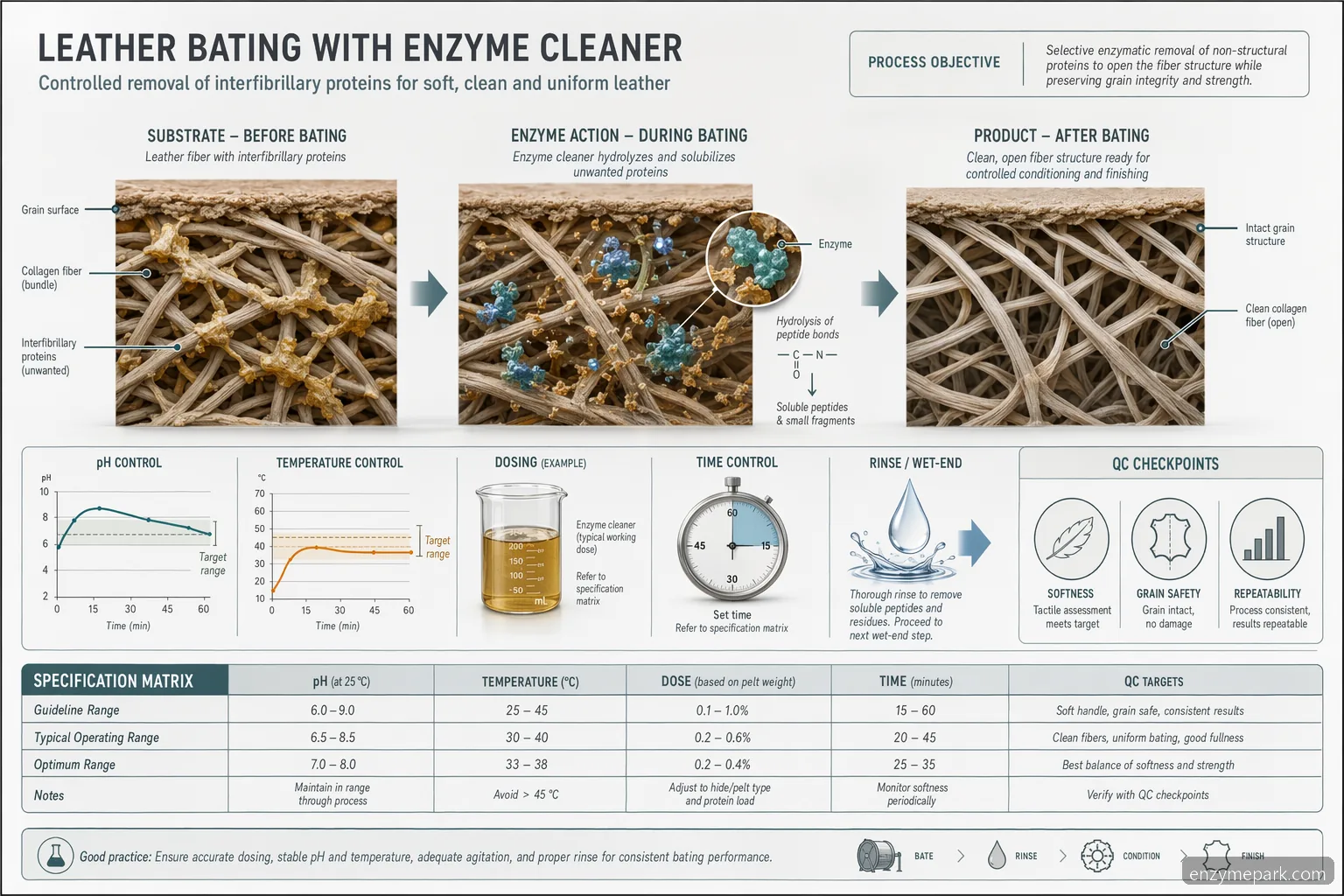
QC Checks for Safe and Repeatable Leather Bating
Quality control should confirm that the enzyme cleaner leather process improves handle without weakening the substrate. Before bating, verify deliming uniformity, residual lime, pH profile, and pelt temperature. During bating, monitor bath pH, temperature, time, float movement, and enzyme addition records. After bating, inspect grain tightness, scud removal, slipperiness, stretch, softness, and cross-section opening. For production approval, compare physical test data such as tensile strength, tear strength, elongation, and shrinkage temperature after tanning against the standard process. Visual grading should include grain break, vein prominence, looseness, and dye uniformity. If an enzyme cleaner on leather causes excessive softness, grain looseness, or reduced strength, reduce dosage, time, temperature, or pH exposure. Repeatable bating depends on both enzyme activity and upstream consistency in liming and deliming.
Record pH and temperature at start, midpoint, and endpoint • Retain control samples from non-enzyme or current-standard lots • Check physical strength after tanning, not only wet pelt feel • Investigate upstream variation before changing enzyme dosage
Supplier Qualification and Documentation
A qualified leather processing enzyme supplier should provide a current COA, TDS, and SDS for every commercial product. The COA should identify lot number, activity or assay result, appearance, and relevant storage or shelf-life information. The TDS should state application range, recommended pH and temperature, dosage guidance, compatibility notes, and inactivation recommendations if applicable. The SDS should support safe handling, storage, spill response, and worker protection procedures. For enzyme tanning support, dehairing aids, and bating enzyme programs, ask how activity is measured and whether the assay correlates with tannery performance. Avoid relying only on label strength or generic terms such as enzyme cleaner leather safe. Supplier qualification should include sample testing, pilot validation, batch-to-batch review, logistics capability, technical support, and change-notification expectations.
Request COA, TDS, and SDS before pilot approval • Confirm activity assay method and unit definition • Review storage temperature and shelf-life conditions • Ask for technical support during scale-up
Cost-in-Use and Scale-Up Considerations
The lowest price per kilogram is rarely the best way to compare leather enzymes. Cost-in-use should include active enzyme strength, dosage, process time, drum capacity, rework reduction, chemical savings, effluent impact, finished leather yield, and grade improvement. A concentrated bating enzyme may cost more per kilogram but use less product, reduce lot variation, or improve softness consistency. During pilot validation, run at least one control lot and one optimized enzyme lot through tanning, retanning, dyeing, fatliquoring, drying, and staking before final judgment. If buyers search for enzyme cleaner for leather, enzyme cleaner safe for leather, or enzyme cleaner leather safe, the purchasing decision should still be based on measurable wet-end performance. Document the approved process window and create a change-control plan before shifting from pilot to routine production.
Compare cost per processed hide or square foot, not only product price • Include rework, rejects, and grade outcomes in the calculation • Validate through finished leather, not only wet-blue or wet-white stage • Lock process limits before full production rollout
Technical Buying Checklist
Buyer Questions
No. In this industrial context, a leather safe enzyme cleaner refers to a controlled leather processing enzyme for bating or related wet-end preparation. It is not the same as a household enzyme cleaner for leather couch care, car seats, or pet stains. Finished leather can be damaged by moisture, alkalinity, surfactants, or proteases, so consumer cleaning decisions should follow the article maker’s instructions.
Start with hide type, beamhouse process, softness target, and tannage route. Request the supplier’s COA, TDS, SDS, activity method, dosage range, pH and temperature guidance, and compatibility notes. Then run controlled pilot trials against your current process. Evaluate grain, softness, scud removal, dyeing, tensile strength, tear strength, and final leather grade before approving routine use.
Many protease bating systems are initially screened around pH 7.5–9.0 and 30–40 °C, but the correct range depends on enzyme design, substrate, deliming endpoint, and required handle. Always follow the supplier TDS and validate in your drums. Excessive pH, temperature, time, or dosage can increase the risk of over-bating, looseness, or strength loss.
It can, but savings must be proven by cost-in-use analysis rather than product price alone. Compare dosage, activity, process time, reject rate, rework, finished leather area, grade improvement, effluent contribution, and chemical adjustments. A higher-priced enzyme may be economical if it improves consistency or reduces defects. Pilot validation through finished leather is essential before commercial approval.
At minimum, request a COA for lot-specific quality, a TDS for application conditions, and an SDS for safe handling. For supplier qualification, also ask for activity assay details, recommended storage, shelf life, packaging, batch traceability, change-notification practices, and technical support availability. These documents help purchasing, production, QC, and EHS teams evaluate the product consistently.
Leather Processing Enzymes for Research & Industry
Need Leather Processing Enzymes for your lab or production process?
ISO 9001 certified · Food-grade & research-grade · Ships to 80+ countries
Frequently Asked Questions
Is a leather safe enzyme cleaner the same as a consumer leather cleaner?
No. In this industrial context, a leather safe enzyme cleaner refers to a controlled leather processing enzyme for bating or related wet-end preparation. It is not the same as a household enzyme cleaner for leather couch care, car seats, or pet stains. Finished leather can be damaged by moisture, alkalinity, surfactants, or proteases, so consumer cleaning decisions should follow the article maker’s instructions.
How do I select a bating enzyme for leather production?
Start with hide type, beamhouse process, softness target, and tannage route. Request the supplier’s COA, TDS, SDS, activity method, dosage range, pH and temperature guidance, and compatibility notes. Then run controlled pilot trials against your current process. Evaluate grain, softness, scud removal, dyeing, tensile strength, tear strength, and final leather grade before approving routine use.
What pH and temperature are typical for leather bating?
Many protease bating systems are initially screened around pH 7.5–9.0 and 30–40 °C, but the correct range depends on enzyme design, substrate, deliming endpoint, and required handle. Always follow the supplier TDS and validate in your drums. Excessive pH, temperature, time, or dosage can increase the risk of over-bating, looseness, or strength loss.
Can enzyme bating reduce overall processing cost?
It can, but savings must be proven by cost-in-use analysis rather than product price alone. Compare dosage, activity, process time, reject rate, rework, finished leather area, grade improvement, effluent contribution, and chemical adjustments. A higher-priced enzyme may be economical if it improves consistency or reduces defects. Pilot validation through finished leather is essential before commercial approval.
What documents should a leather enzyme supplier provide?
At minimum, request a COA for lot-specific quality, a TDS for application conditions, and an SDS for safe handling. For supplier qualification, also ask for activity assay details, recommended storage, shelf life, packaging, batch traceability, change-notification practices, and technical support availability. These documents help purchasing, production, QC, and EHS teams evaluate the product consistently.
Related: Cleaner Leather Processing Starts Here
Turn This Guide Into a Supplier Brief Request a leather enzyme sample, COA/TDS/SDS pack, and pilot trial guidance for your bating process. See our application page for Cleaner Leather Processing Starts Here at /applications/leather-safe-enzyme-cleaner/ for specs, MOQ, and a free 50 g sample.
Contact Us to Contributehello@mail.enzymepark.com