Bating Enzyme Leather Process Guide for Tanneries
Optimize leather bating with enzyme selection, process conditions, QC checks, pilot trials, cost-in-use, COA, TDS, SDS, and supplier qualification.
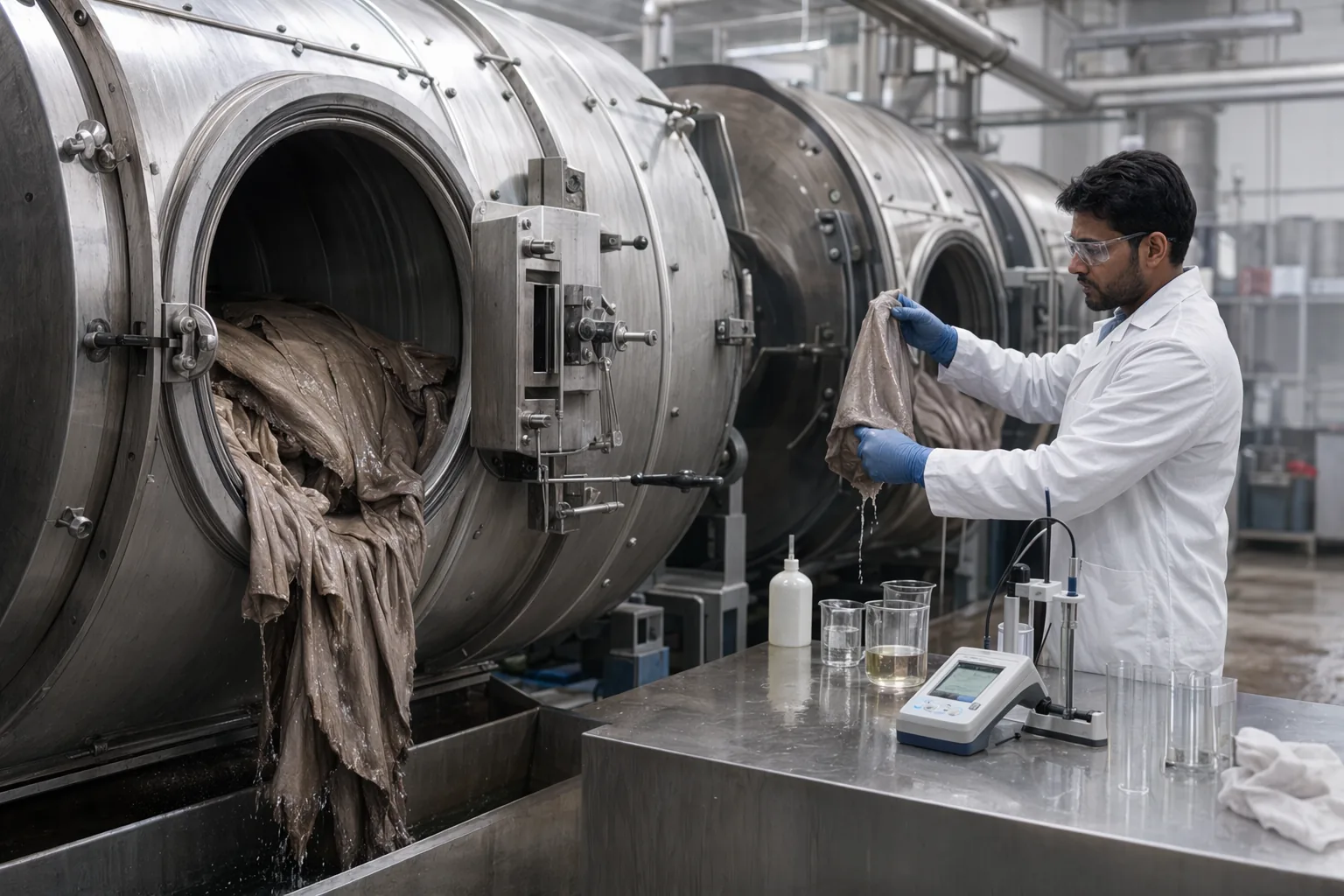
Select and validate the right bating enzyme for leather bating with practical process ranges, control points, and supplier qualification criteria for industrial tannery operations. For tanneries, distributors and resellers buying in bulk: request a quote with the product, quantity and destination.
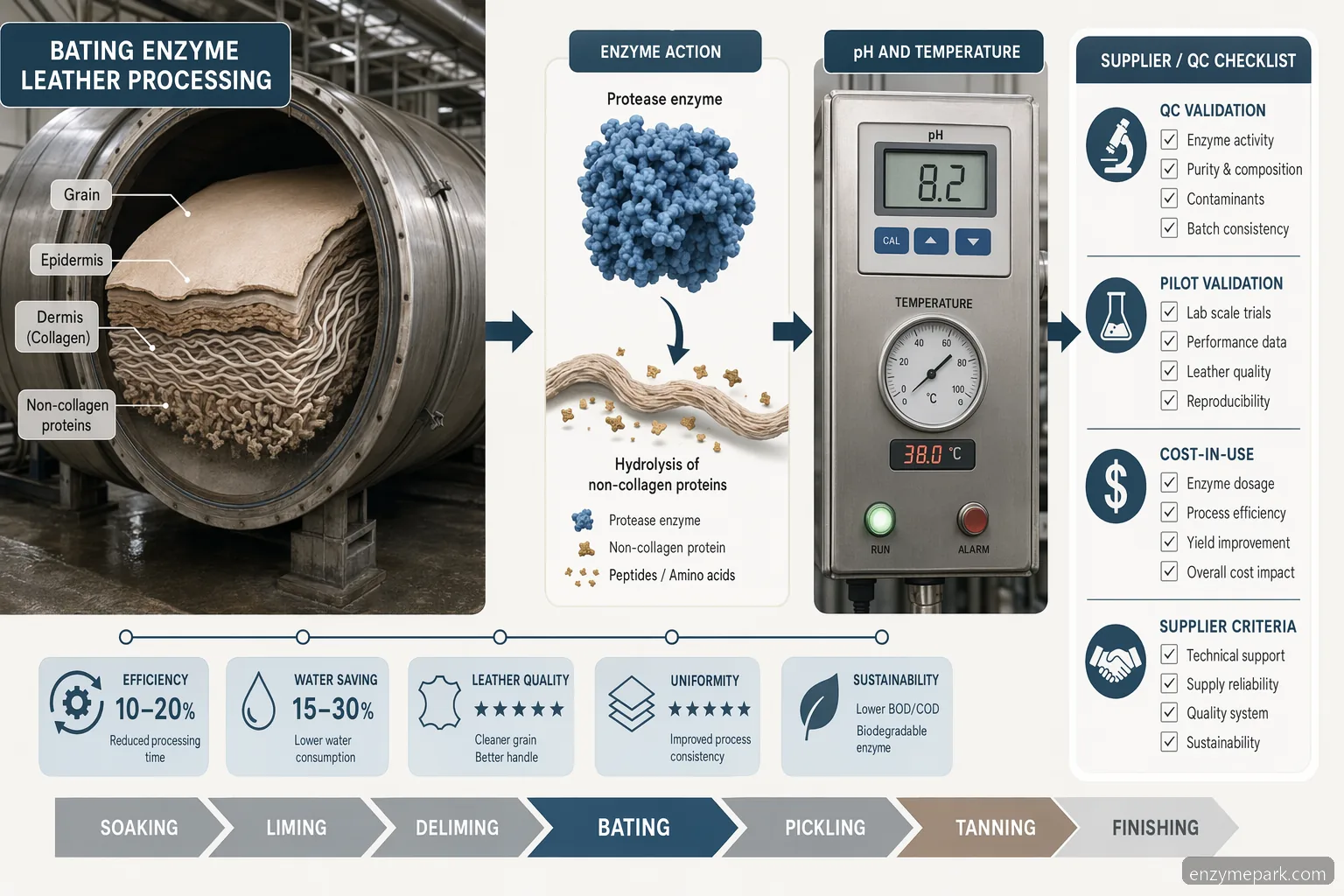
What a Bating Enzyme Does in Leather Processing
A bating enzyme leather process uses controlled proteolytic activity to remove non-structural proteins after liming and deliming. The objective is not to dissolve collagen, but to open the fiber structure, improve grain smoothness, support softness, and prepare the pelt for pickle, tanning, and downstream finishing. In industrial leather bating, enzyme selection depends on animal origin, hide thickness, liming intensity, desired article, and tannery equipment. A mild bating program may suit upholstery or automotive leather where uniform grain and strength retention matter, while a stronger process may be used for softer garment or lining articles. The most suitable leather processing enzyme for leather bating should provide predictable activity under the tannery’s operating pH, temperature, salt, and float conditions. Because enzyme activity changes with process variables, supplier guidance should be validated in a drum trial before plant-wide adoption.
Main purpose: controlled removal of interfibrillary proteins • Typical benefits: cleaner grain, improved softness, more uniform wet-blue or wet-white • Main risk: over-bating, looseness, grain damage, or strength loss
Recommended Process Conditions for Leather Bating
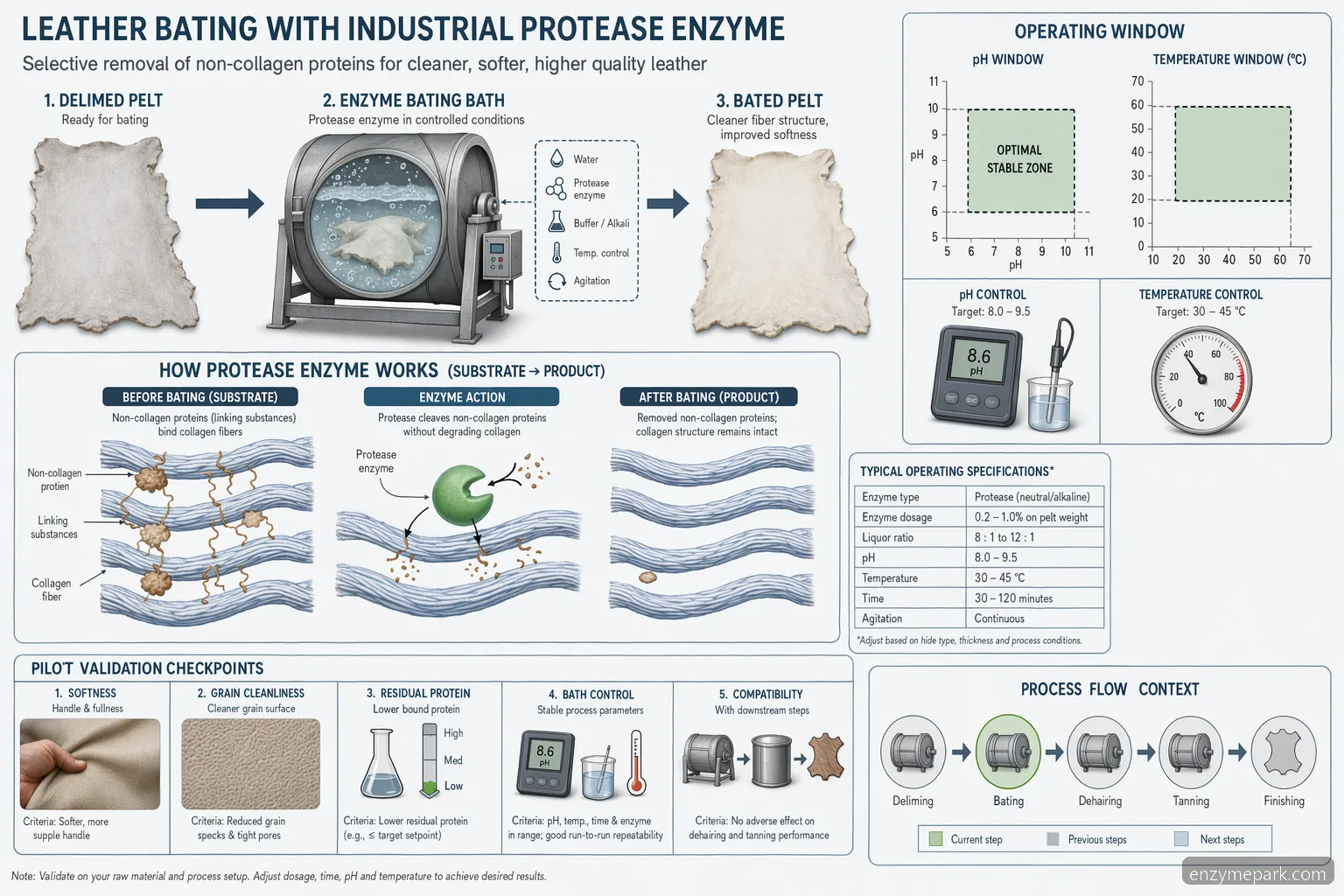
Most industrial bating enzyme leather bating programs are run after deliming, when pH and residual alkalinity are brought into a range compatible with the selected enzyme. Many alkaline or neutral protease products operate around pH 7.5 to 9.0, although exact limits must come from the TDS. Temperature is commonly controlled around 30 to 38°C for bovine hides and adjusted for sensitive skins or thinner materials. Dosage often falls in the range of 0.05% to 0.5% on pelt weight, but activity units, substrate condition, drum action, and processing time are more important than percentage alone. A typical treatment time may be 30 to 90 minutes. Buyers should avoid transferring a recipe directly from one tannery to another without checking pH drift, float length, residual lime, and final leather specification.
pH: commonly near-neutral to mildly alkaline, based on product TDS • Temperature: often 30–38°C, controlled to avoid activity spikes • Dosage: trial within supplier-recommended activity range • Time: typically 30–90 minutes depending on article and drum action
How to Select a Bating Enzyme Supplier
A qualified bating enzyme supplier for leather bating should support more than a product quote. Industrial buyers should request a current COA for each batch, a TDS with activity method and application window, and an SDS for handling, storage, and worker safety review. The supplier should explain whether the enzyme is designed for alkaline bating, neutral bating, low-temperature processing, or specific leather articles. For consistent production, ask about activity tolerance, recommended storage temperature, shelf life, packaging integrity, and traceability. A leather processing enzyme supplier for leather bating should also help translate lab data into drum-scale trials and compare cost-in-use, not just price per kilogram. Supplier qualification may include sample evaluation, pilot validation, documentation review, and commercial batch monitoring before approval.
Request COA, TDS, SDS, shelf-life, and storage guidance • Confirm activity units and test method, not only product concentration • Review technical support for pilot and scale-up trials • Evaluate cost-in-use per ton of pelt or finished area
Pilot Validation and QC Checks
Before adopting a new bating enzyme for leather bating, run a controlled pilot trial against the current process or an untreated reference. Keep pelt source, weight, float, pH, temperature, drum speed, and time constant so enzyme impact can be isolated. During processing, monitor pH at start, mid-point, and end; check deliming completion; and record temperature. After bating, evaluate scud removal, grain cleanliness, handle, openness, and uniformity across butt, belly, and shoulder. For finished or semi-finished leather, compare tensile strength, tear strength, elongation, grain break, dye uniformity, area yield, and cutting value where relevant. A robust trial should include low, target, and high dosage bands to identify the operating window and avoid over-bating. Document results with photos, lab tests, and operator observations.
Use a control drum and a clear dosage ladder • Measure pH, temperature, time, and float ratio • Check grain, softness, strength, dyeing, and area yield • Confirm performance over more than one raw material lot
Cost-in-Use for Industrial Leather Bating
The lowest purchase price is not always the lowest processing cost. Cost-in-use for an industrial leather processing enzyme leather bating program should consider dosage, activity consistency, rework reduction, process time, water and chemical interactions, final leather quality, and rejection rate. A concentrated enzyme may cost more per kilogram but require a lower dose or provide a wider process window. Conversely, an inexpensive product may increase variability if activity declines during storage or if performance depends on narrow temperature control. Buyers should calculate enzyme cost per metric ton of pelt and, where possible, per square meter or square foot of accepted leather. Include the value of smoother grain, reduced defects, uniform dyeing, and lower risk of strength loss. A validated enzyme tanning and bating process should support predictable production economics.
Compare cost per ton of pelt, not only cost per kilogram • Include defect reduction, rework, and yield impacts • Check activity stability during storage and transport • Model cost across low, target, and high dosage conditions
Cleaner, Dehairing, and Tanning Compatibility
Search terms such as leather safe enzyme cleaner or enzyme cleaner for leather can refer to consumer care products, but tannery bating enzymes are industrial processing aids and should be evaluated under tannery conditions. They may interact with surfactants, deliming agents, degreasers, salt, and subsequent pickle or tanning chemistry. In dehairing, different enzyme systems may be used to support hair loosening, but those products are not automatically suitable for bating. In enzyme tanning workflows, compatibility depends on the sequence, pH transition, and residual activity before tanning agents are introduced. If excessive enzyme activity carries forward, it may affect grain quality or mechanical strength. For this reason, the TDS should define application boundaries, and pilot trials should confirm that the selected leather processing enzyme delivers the intended effect without disrupting downstream tanning, retanning, dyeing, or finishing.
Do not substitute consumer leather cleaner for tannery bating enzyme • Confirm compatibility with deliming, degreasing, pickle, and tanning steps • Use separate validation for dehairing and bating applications • Control residual activity before downstream processing
Specification Checklist for Comparing Bating Enzymes
When comparing industrial leather enzymes for leather bating, request a clear specification rather than a generic product description. The technical data sheet should state enzyme type, declared activity method, recommended pH range, temperature range, dosage guidance, storage conditions, and compatibility notes. The correct pH and temperature range depends on the enzyme source and the tannery process. Dosage is trialed by weight or by activity units, then adjusted according to pelt thickness and desired article. A certificate of analysis should confirm batch identity and activity. The safety data sheet should cover safe handling, respiratory sensitization precautions, spills, and disposal guidance suitable for industrial use.
Ask whether dosage is weight-based, activity-based, or both. • Confirm activity test method and unit definition. • Check shelf life and storage temperature before buying bulk lots. • Verify compatibility with deliming salts, surfactants, and auxiliaries.
Side-by-Side Pilot Comparison of Two Bating Enzymes
Pilot validation should reproduce the intended plant conditions as closely as possible: hide or skin source, lime split condition, deliming endpoint, float percentage, drum speed, temperature, pH, time, and mechanical action. Run the incumbent bating enzyme and the challenger enzyme side by side, preferably with a blank or reduced-dose control when practical. Track pH at start and finish, float temperature, process time, and any adjustment chemicals used. Evaluate the pelt immediately after bating for scud removal, slipperiness, grain smoothness, fullness, and cross-sectional opening. Continue the comparison through pickling, tanning, retanning, dyeing, and finishing where possible, because bating differences can appear later as shade variation, loose grain, poor break, or changed softness. Pilot results should be recorded in a format that purchasing, production, and quality teams can review together before supplier approval.
Use equal pelt weight, float, time, and drum action for each trial. • Compare finished leather, not only wet pelt feel. • Record rework, rejects, and chemical adjustments.
Technical Buying Checklist
Buyer Questions
Many bating enzyme leather processes run near neutral to mildly alkaline conditions, commonly around pH 7.5 to 9.0, but the best range depends on the enzyme type and hide condition. Always follow the supplier TDS and confirm pH during the drum run. Residual lime, deliming chemistry, and pH drift can change actual enzyme activity and final leather quality.
A typical starting range is often 0.05% to 0.5% on pelt weight, but dosage must be based on enzyme activity, pelt condition, temperature, time, and target article. The safest approach is a pilot dosage ladder with low, target, and high levels. Evaluate grain cleanliness, softness, strength, area yield, and signs of looseness before setting a production recipe.
Request COA, TDS, SDS, activity method, storage guidance, shelf life, and traceability information. Then run a pilot trial using your hides, drums, deliming process, and quality targets. A suitable supplier should support scale-up, explain cost-in-use, and provide consistent batch activity. Qualification should be based on documented performance, technical support, and supply reliability.
No. A leather safe enzyme cleaner or enzyme cleaner for leather is usually designed for cleaning finished leather or surfaces, not for controlled tannery bating. Industrial bating enzymes are selected by activity profile, pH tolerance, temperature range, and effect on hide fiber structure. Substitution can cause poor performance, staining, grain damage, or inconsistent processing.
Useful QC checks include pH and temperature records, deliming completion, visual scud removal, grain cleanliness, softness, and uniformity across hide areas. For validation, compare tensile strength, tear strength, elongation, grain break, dye uniformity, and area yield against a control. Good records help define an operating window and reduce the risk of under-bating or over-bating.
Related Search Themes
leather safe enzyme cleaner, enzyme cleaner for leather, leather processing enzyme supplier for leather bating, leather processing enzyme for leather bating, industrial leather processing enzyme leather bating, industrial bating enzyme leather bating
Request a Quote: Wholesale Supply for Tanneries and Resellers
We supply leather processing enzymes to tanneries, leather chemical distributors and resellers on a quote basis. Our Leather Processing Enzymes (Protease 200,000+ U/g; Lipase 50,000+ U/g) ship as light brown powder or granule in 25 kg fiber drums, with an MOQ of 25 kg; prices are quoted per order.
To get a quote, send three things: the product (Leather Processing Enzymes), the quantity per order or per month, and the destination country or port. Add your hide type and process stage if you also want trial guidance with the quote.
Use the quote form on the home page or email hello@mail.enzymepark.com.
Leather Processing Enzymes for Research & Industry
Need Leather Processing Enzymes for your lab or production process?
ISO 9001 certified · Food-grade & research-grade · Ships to 80+ countries
Frequently Asked Questions
What is the best pH for bating enzyme leather processing?
Many bating enzyme leather processes run near neutral to mildly alkaline conditions, commonly around pH 7.5 to 9.0, but the best range depends on the enzyme type and hide condition. Always follow the supplier TDS and confirm pH during the drum run. Residual lime, deliming chemistry, and pH drift can change actual enzyme activity and final leather quality.
How much bating enzyme should a tannery use?
A typical starting range is often 0.05% to 0.5% on pelt weight, but dosage must be based on enzyme activity, pelt condition, temperature, time, and target article. The safest approach is a pilot dosage ladder with low, target, and high levels. Evaluate grain cleanliness, softness, strength, area yield, and signs of looseness before setting a production recipe.
How do we qualify a leather processing enzyme supplier for leather bating?
Request COA, TDS, SDS, activity method, storage guidance, shelf life, and traceability information. Then run a pilot trial using your hides, drums, deliming process, and quality targets. A suitable supplier should support scale-up, explain cost-in-use, and provide consistent batch activity. Qualification should be based on documented performance, technical support, and supply reliability.
Can a leather safe enzyme cleaner be used as a bating enzyme?
No. A leather safe enzyme cleaner or enzyme cleaner for leather is usually designed for cleaning finished leather or surfaces, not for controlled tannery bating. Industrial bating enzymes are selected by activity profile, pH tolerance, temperature range, and effect on hide fiber structure. Substitution can cause poor performance, staining, grain damage, or inconsistent processing.
What QC tests confirm that leather bating is controlled?
Useful QC checks include pH and temperature records, deliming completion, visual scud removal, grain cleanliness, softness, and uniformity across hide areas. For validation, compare tensile strength, tear strength, elongation, grain break, dye uniformity, and area yield against a control. Good records help define an operating window and reduce the risk of under-bating or over-bating.
How should a tannery compare two bating enzyme suppliers?
Compare suppliers using the same hide type, pelt weight, float, pH, temperature, time, and mechanical action. Review COA, TDS, SDS, activity method, shelf life, and traceability. Then evaluate finished leather quality, not only wet pelt feel. Cost-in-use should include dosage, rework, rejects, strength, softness, shade uniformity, and technical support.
Related: Cleaner Leather Processing Starts Here
Turn This Guide Into a Supplier Brief Contact EnzymePark to request samples, COA/TDS/SDS, and pilot support for bating enzyme leather trials. See our application page for Cleaner Leather Processing Starts Here at /applications/leather-safe-enzyme-cleaner/ for specs, MOQ, and a free 50 g sample.
Contact Us to Contributehello@mail.enzymepark.com