Enzyme Cleaner for Leather Couch: Leather Processing Enzymes Supplier Guide for Bating
B2B guide to leather enzymes for bating, dehairing, tanning support, QC, pilot validation, COA/TDS/SDS, and supplier qualification.
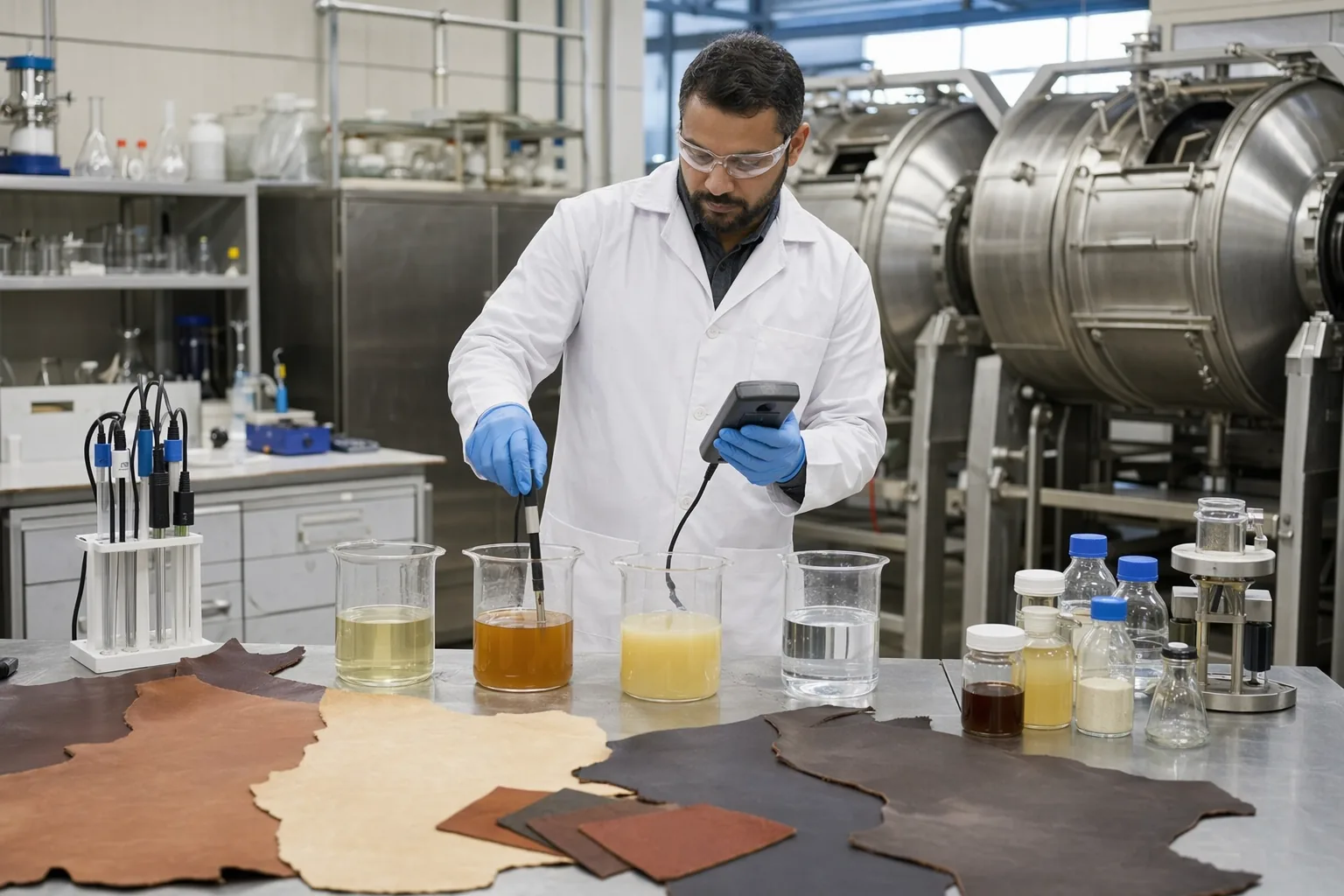
For tanneries, leather chemical distributors, and private-label cleaner formulators, enzyme selection must balance cleaning performance, grain safety, process control, and documented quality.
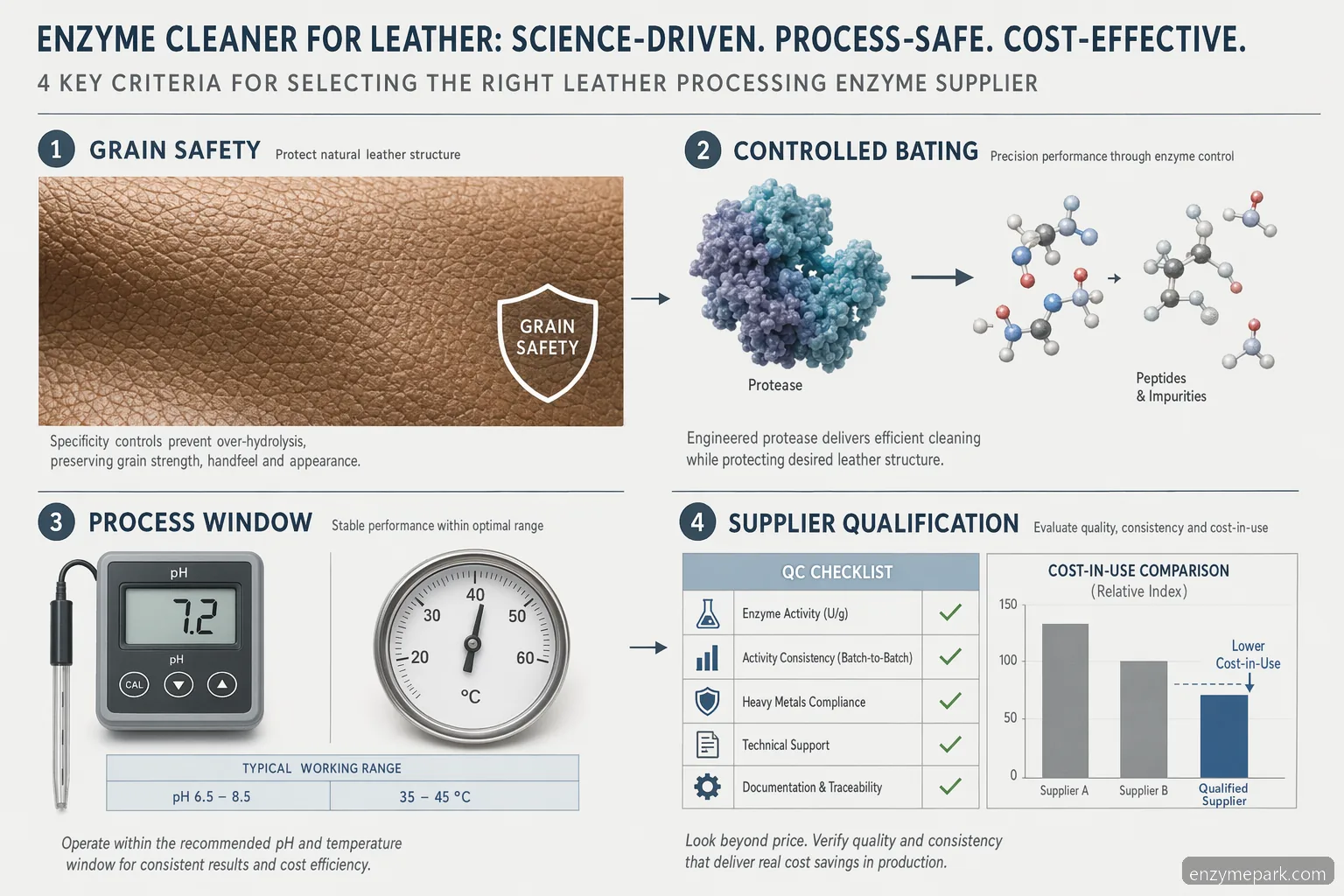
Buyer Intent Behind Enzyme Cleaner for Leather Couch
Searches for enzyme cleaner for leather couch often come from buyers looking for a leather safe enzyme cleaner, but industrial purchasers need more than a household cleaning claim. Tanneries, leather-care brands, automotive detailing suppliers, and chemical distributors must define whether the enzyme is intended for wet-end leather processing, finished-leather maintenance, or stain-removal formulation. These are different applications with different risk profiles. A leather processing enzyme used for bating is not automatically suitable as an enzyme cleaner on leather furniture, and a formulated enzyme cleaner for leather may not be appropriate for beamhouse operations. B2B evaluation should start with leather type, finish system, target soils, process temperature, exposure time, and acceptable changes in color, handle, tensile strength, and grain tightness. The supplier should help translate commercial claims into measurable specifications, pilot protocols, and documentation.
Define wet-end processing versus finished-leather cleaning. • Confirm compatibility with aniline, semi-aniline, pigmented, or coated leather. • Avoid assuming one enzyme product fits couch, car seat, and tannery use.
Leather Bating: Practical Enzyme Process Window
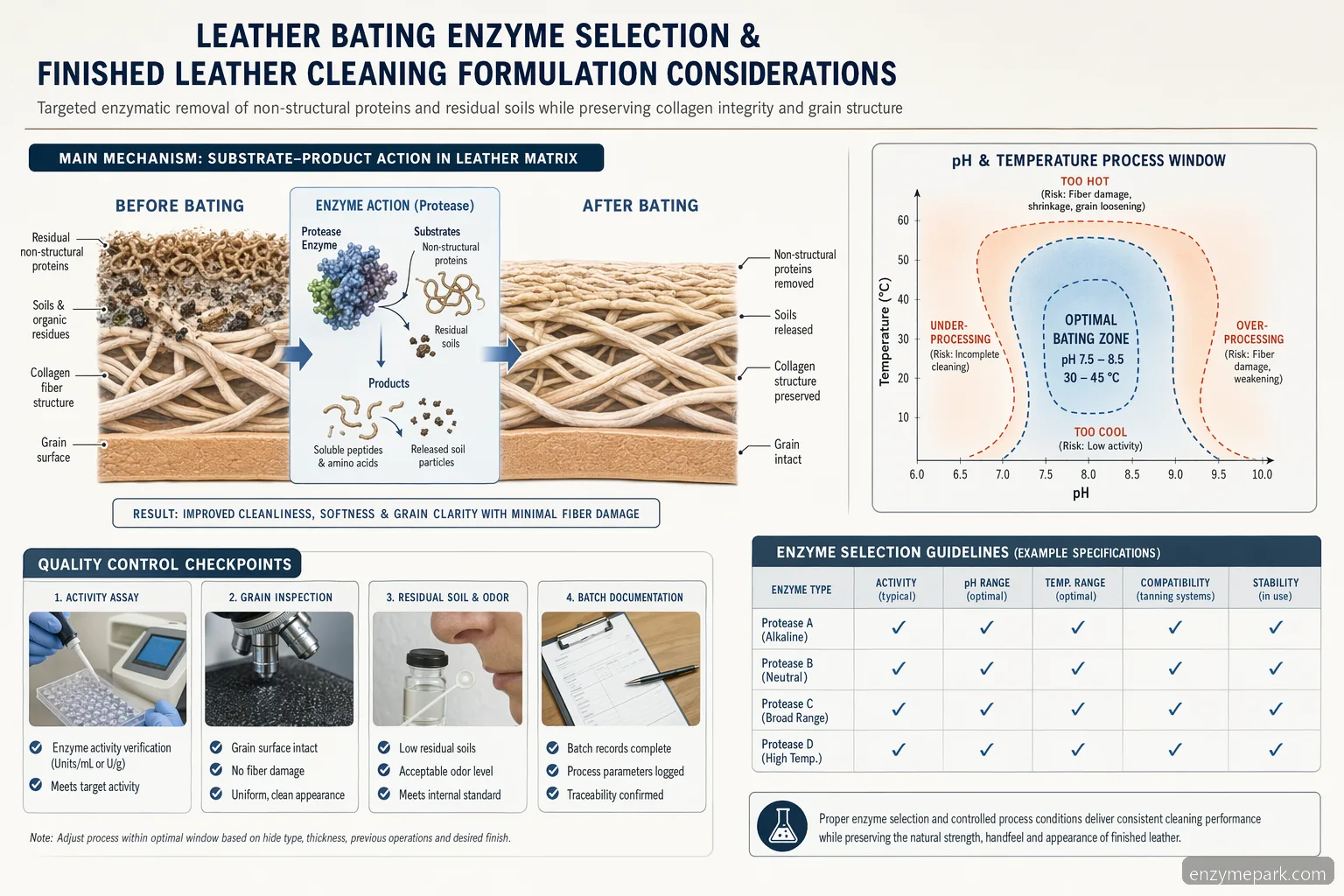
In leather bating, proteolytic enzymes are used after liming and deliming to remove non-structural proteins, improve softness, help open the fiber structure, and prepare hides or skins for downstream tanning. Common operating windows are mildly alkaline to near-neutral, often pH 7.5 to 9.0, at 30 to 40°C, with dosage commonly evaluated around 0.05% to 0.50% on pelt weight depending on enzyme activity, hide type, float length, and desired handle. Contact time may range from 30 to 90 minutes in pilot trials, but should be set by pelt response rather than a fixed claim. Over-bating can loosen grain and reduce strength, while under-bating can leave harshness and uneven dyeing. The best bating enzyme program is controlled by activity, drum conditions, process timing, and repeatable QC checks.
Typical pH screen: 7.5 to 9.0. • Typical temperature screen: 30 to 40°C. • Typical dosage screen: 0.05% to 0.50% on pelt weight. • Validate by handle, grain, strength, and dye uniformity.
Finished Leather Cleaning and Formulation Considerations
If the commercial target is an enzyme cleaner for leather couch, enzyme cleaner for leather car seats, or enzyme cleaner for leather seats, the formulation must be developed for finished leather rather than raw hide processing. Finished leather can include pigments, polyurethane topcoats, waxes, oils, dyes, and sensitive feel modifiers. A leather enzyme cleaner for this market generally requires mild pH, low residue, controlled enzyme activity, and compatibility with surfactants, preservatives, solvents, fragrance, and packaging. Proteases may help with protein-based soils, while lipases may support oily soils, but both can affect finishes if concentration or dwell time is excessive. The question, can I use enzyme cleaner on leather, cannot be answered responsibly without knowing the leather finish and formulation. Industrial buyers should request application-specific data, spot-test protocols, and accelerated storage stability before launch.
Target mild pH unless the finish system supports otherwise. • Check color rub-off, gloss change, tackiness, and odor. • Do not use bating dosage assumptions for finished goods.
QC Checks for Leather Processing Enzyme Selection
Quality control should connect enzyme activity to leather performance. For a bating enzyme, incoming QC may include declared activity method, appearance, moisture, pH of solution, solubility or dispersibility, microbial limits where relevant, and batch-to-batch activity tolerance. Process QC can include pH and temperature logging, float ratio, drum time, deliming endpoint, and residual lime indicators. Leather QC after bating should evaluate grain smoothness, scud removal, softness, fullness, tensile strength, tear strength, elongation, shrinkage temperature after tanning, dye uptake, and uniformity. For an enzyme cleaner leather formulation, QC should include cleaning performance on defined soils, finish compatibility, viscosity, odor, microbial stability, and aging tests. A supplier should provide COA, TDS, and SDS for each commercial grade, and the buyer should confirm that test methods are relevant to the intended application.
Match enzyme activity assay to intended use. • Track batch activity and storage conditions. • Use leather-performance data, not activity data alone. • Retain samples for complaint investigation.
Pilot Validation Before Plant or Product Launch
Pilot validation reduces risk before committing to full-scale purchasing. For leather bating, run side-by-side trials against the current enzyme or chemical process using the same hide selection, soak history, liming, deliming, float ratio, drum speed, pH, temperature, and time. Evaluate at least a low, target, and high dosage to identify a safe operating band. For enzyme cleaner for leather development, test the candidate formula on representative leather types, including light colors and high-risk finishes. Include controlled dwell times, wiping methods, drying conditions, and repeated-use simulations. Document pass and fail criteria before testing starts. Pilot results should support cost-in-use calculations, claims substantiation, and scale-up instructions. A serious enzyme supplier should help design trials, interpret data, and adjust grade, dosage, or formulation rather than simply providing a sample.
Run low, target, and high dosage trials. • Use matched control hides or leather panels. • Define pass/fail criteria before testing. • Document scale-up changes from lab to drum or production line.
Cost-in-Use and Supplier Qualification
The lowest price per kilogram is rarely the best measure for leather enzymes. Cost-in-use should account for enzyme activity, effective dosage, rework reduction, processing time, water and energy impact, downstream dyeing consistency, rejected leather area, storage stability, and operator handling. A concentrated enzyme may be economical if it delivers a wider process window and fewer defects; a cheaper product may be costly if activity drifts or technical support is weak. Supplier qualification should review manufacturing consistency, COA availability, TDS clarity, SDS compliance, batch traceability, lead time, packaging options, shelf-life data, and responsiveness during pilot work. For distributors and OEM formulators, private-label support, documentation control, and formulation confidentiality also matter. The goal is a dependable leather processing enzyme program that performs consistently in real tannery or finished-leather conditions.
Compare cost per processed hide or finished unit. • Confirm batch traceability and shelf life. • Request technical support for trials and troubleshooting. • Review COA, TDS, and SDS before purchase.
Technical Buying Checklist
Buyer Questions
For B2B purposes, can I use enzyme cleaner on leather depends on the leather finish, enzyme type, concentration, pH, dwell time, and cleaning method. Finished leather may contain pigments, coatings, oils, and dyes that can react differently. Industrial buyers should not rely on a generic claim. Request formulation data, run spot tests, and validate color, gloss, feel, and residue before approval.
No. A bating enzyme is designed for wet-end leather processing, usually on delimed pelts before tanning. An enzyme cleaner for leather couch products is a finished-goods formulation challenge involving mild cleaning, finish compatibility, residue control, and consumer-use safety instructions. The same enzyme family may be considered, but dosage, pH, stabilizers, surfactants, and validation methods are very different.
A qualified supplier should provide a COA for batch-specific quality, a TDS with application guidance, and an SDS covering handling and safety information. Buyers should also request activity method, recommended storage, shelf life, packaging options, allergen or sensitization handling precautions where relevant, and pilot support. Documentation should match the exact product grade being purchased, not only a general product family.
A practical pilot range for leather bating enzyme is often 0.05% to 0.50% on pelt weight, but final dosage depends on enzyme activity, pH, temperature, hide type, float ratio, drum action, and target softness. Start with controlled side-by-side trials against your current process. Evaluate grain tightness, scud removal, softness, strength, dyeing, and consistency before scaling to production.
Compare suppliers by application fit, documentation quality, batch consistency, pilot responsiveness, cost-in-use, and realistic technical claims. For enzyme cleaner for leather or leather safe enzyme cleaner projects, request data on pH stability, surfactant compatibility, preservative compatibility, storage stability, and finished-leather testing. For tannery enzymes, review process window, activity tolerance, performance in pilot drums, and troubleshooting support.
Yes, enzymes can support dehairing, bating, and certain enzyme tanning preparation steps, but each use requires a different performance target and control strategy. Dehairing support may focus on reducing harsh chemical load, while bating targets non-structural protein removal and softness. Enzyme tanning language should be validated carefully, because tanning performance depends on the complete chemistry, not the enzyme alone.
Request a Quote: Wholesale Supply for Tanneries and Resellers
We supply leather processing enzymes to tanneries, leather chemical distributors and resellers on a quote basis. Our Leather Processing Enzymes (Protease 200,000+ U/g; Lipase 50,000+ U/g) ship as light brown powder or granule in 25 kg fiber drums, with an MOQ of 25 kg; prices are quoted per order.
To get a quote, send three things: the product (Leather Processing Enzymes), the quantity per order or per month, and the destination country or port. Add your hide type and process stage if you also want trial guidance with the quote.
Use the quote form on the home page or email hello@mail.enzymepark.com.
Leather Processing Enzymes for Research & Industry
Need Leather Processing Enzymes for your lab or production process?
ISO 9001 certified · Food-grade & research-grade · Ships to 80+ countries
Frequently Asked Questions
Can I use enzyme cleaner on leather?
For B2B purposes, can I use enzyme cleaner on leather depends on the leather finish, enzyme type, concentration, pH, dwell time, and cleaning method. Finished leather may contain pigments, coatings, oils, and dyes that can react differently. Industrial buyers should not rely on a generic claim. Request formulation data, run spot tests, and validate color, gloss, feel, and residue before approval.
Is a bating enzyme the same as an enzyme cleaner for leather couch products?
No. A bating enzyme is designed for wet-end leather processing, usually on delimed pelts before tanning. An enzyme cleaner for leather couch products is a finished-goods formulation challenge involving mild cleaning, finish compatibility, residue control, and consumer-use safety instructions. The same enzyme family may be considered, but dosage, pH, stabilizers, surfactants, and validation methods are very different.
What documents should a leather enzyme supplier provide?
A qualified supplier should provide a COA for batch-specific quality, a TDS with application guidance, and an SDS covering handling and safety information. Buyers should also request activity method, recommended storage, shelf life, packaging options, allergen or sensitization handling precautions where relevant, and pilot support. Documentation should match the exact product grade being purchased, not only a general product family.
What is a typical dosage for leather bating enzyme?
A practical pilot range for leather bating enzyme is often 0.05% to 0.50% on pelt weight, but final dosage depends on enzyme activity, pH, temperature, hide type, float ratio, drum action, and target softness. Start with controlled side-by-side trials against your current process. Evaluate grain tightness, scud removal, softness, strength, dyeing, and consistency before scaling to production.
How should buyers compare enzyme cleaner for leather suppliers?
Compare suppliers by application fit, documentation quality, batch consistency, pilot responsiveness, cost-in-use, and realistic technical claims. For enzyme cleaner for leather or leather safe enzyme cleaner projects, request data on pH stability, surfactant compatibility, preservative compatibility, storage stability, and finished-leather testing. For tannery enzymes, review process window, activity tolerance, performance in pilot drums, and troubleshooting support.
Can enzymes support dehairing and enzyme tanning processes?
Yes, enzymes can support dehairing, bating, and certain enzyme tanning preparation steps, but each use requires a different performance target and control strategy. Dehairing support may focus on reducing harsh chemical load, while bating targets non-structural protein removal and softness. Enzyme tanning language should be validated carefully, because tanning performance depends on the complete chemistry, not the enzyme alone.
Related: Cleaner Leather Processing Starts Here
Turn This Guide Into a Supplier Brief Contact EnzymePark to discuss leather processing enzyme samples, COA/TDS/SDS documentation, and pilot validation for your bating or leather-care formulation. See our application page for Cleaner Leather Processing Starts Here at /applications/leather-safe-enzyme-cleaner/ for specs, MOQ, and a free 50 g sample.
Contact Us to Contributehello@mail.enzymepark.com