Enzyme Cleaner for Leather: Leather Processing Enzymes Specification Checklist for Leather Bating
Compare leather enzyme cleaner claims with industrial bating enzyme specs: pH, temperature, dosage, QC, COA/TDS/SDS, and supplier checks.
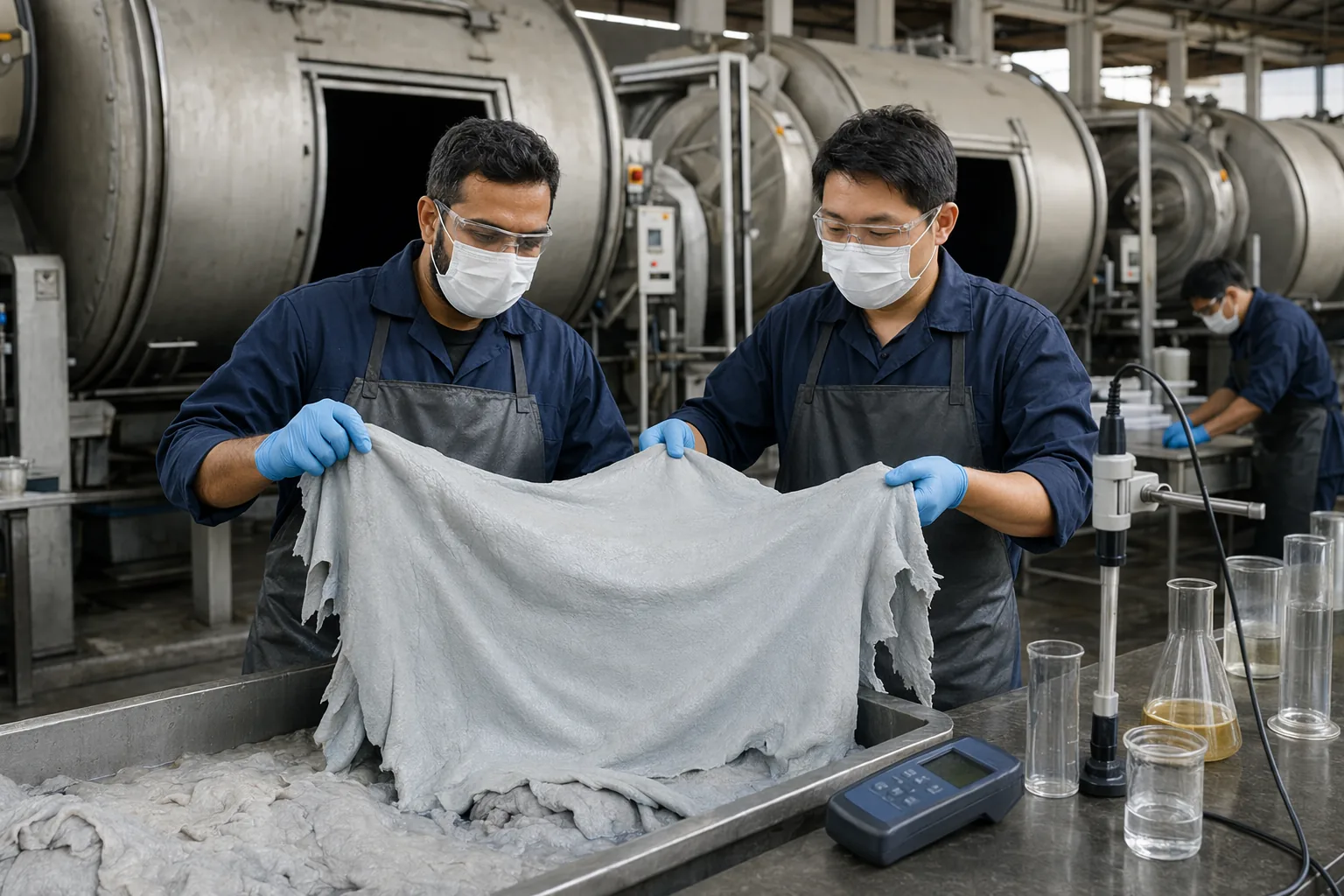
For tanneries, the right enzyme cleaner for leather is not a retail spot remover. It is a controlled leather processing enzyme selected for bating performance, grain quality, process stability, and cost-in-use.
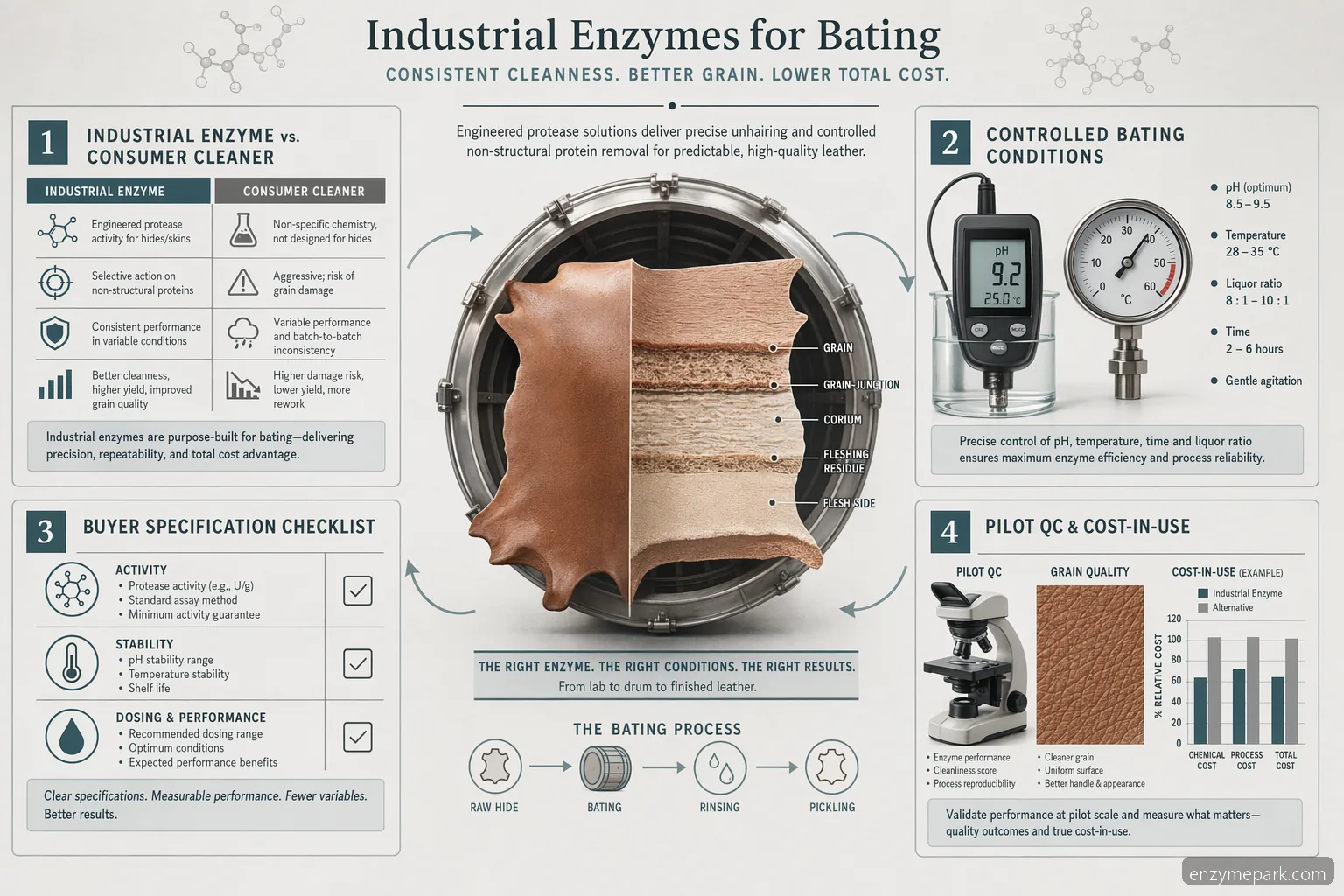
Consumer Cleaner vs Industrial Leather Bating Enzyme
Search terms such as enzyme cleaner for leather couch, enzyme cleaner for leather car seats, and can I use enzyme cleaner on leather usually refer to consumer stain removal. Tanneries have a different requirement: controlled enzymatic treatment of limed hides or skins before tanning. A leather processing enzyme for bating helps remove non-collagenous proteins, improve softness, support grain cleanliness, and prepare the substrate for consistent tanning. The comparison should focus on process fit, not household cleaning claims. A leather safe enzyme cleaner may be mild on finished leather, but it may have no measurable value in beamhouse operations. For leather bating, buyers should ask what enzyme class is supplied, how activity is measured, which pH and temperature window is recommended, and how performance is verified in drums. The correct enzyme cleaner leather specification must be tied to wet-end process control, not surface care language.
Finished leather cleaning is not the same as bating. • Industrial enzyme tanning support depends on controlled process conditions. • Performance should be validated on the tannery’s own hide or skin type.
Core Process Conditions for Leather Bating
Most bating enzyme programs are evaluated after deliming, when pH has been reduced from liming conditions to a range suitable for protease activity. A common working window is pH 7.5 to 9.0, although exact conditions depend on the enzyme formulation, raw material, and target article. Typical drum temperatures may run from 30 to 38°C for many bovine and small-skin processes. Dosage is often screened in a band such as 0.05% to 0.30% on pelt weight, then adjusted by activity, time, float length, and required softness. These are starting ranges, not universal instructions. Excessive activity, extended time, or high temperature can cause loose grain, loss of substance, or inconsistent break. A reliable leather enzyme cleaner for bating should include a clear TDS with recommended pH, temperature, addition point, dosage basis, and deactivation or rinse guidance.
Typical screening pH: 7.5 to 9.0. • Typical screening temperature: 30 to 38°C. • Common trial dosage band: 0.05% to 0.30% on pelt weight. • Confirm final settings through pilot drum validation.
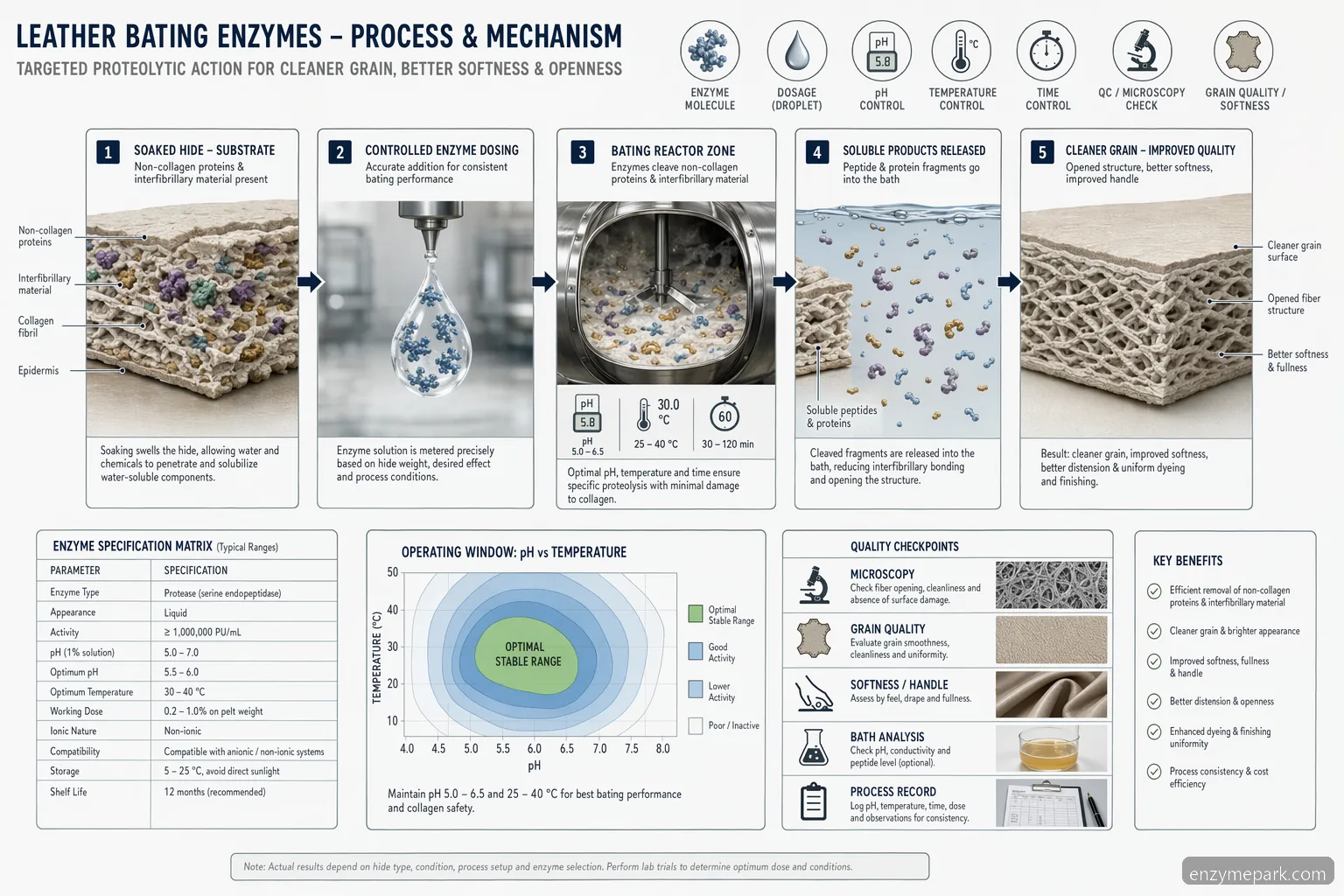
Specification Checklist for B2B Buyers
When comparing enzyme cleaner on leather claims, convert marketing language into measurable specifications. Ask for enzyme type, declared activity, analytical method, carrier system, physical form, solubility, recommended storage, shelf life, and lot-to-lot tolerance. The Certificate of Analysis should match the supplied batch and include the activity value or agreed release parameters. The Technical Data Sheet should define process conditions and compatibility with deliming agents, surfactants, degreasers, salts, and common tanning auxiliaries where applicable. The Safety Data Sheet should support handling, dust control, PPE review, transport classification, and plant risk assessment. For leather bating, the strongest suppliers also provide pilot support, troubleshooting guidance, and scale-up recommendations. This is especially important when the same plant processes different raw stocks, thicknesses, or end articles such as upholstery, automotive, footwear, or garment leather.
Request COA for each supplied lot. • Review TDS before trials. • Review SDS with EHS and production teams. • Confirm compatibility with the current beamhouse recipe.
Pilot Validation and QC Checks
A pilot trial should compare the candidate enzyme against the current bating enzyme, not against an unrelated leather safe enzyme cleaner. Use matched hides or skins, equal deliming status, controlled float, fixed temperature, and defined run time. Record pH at start, during operation, and at discharge. Check grain cleanliness, scud removal, handle, softness, belly looseness, tear strength risk, and uniformity through the cross-section. Practical QC may include residual lime checks, phenolphthalein cut, pH of pelt sections, visual grain inspection, tactile assessment after tanning, and final physical testing according to the tannery’s normal methods. If the goal is cleaner grain with less mechanical action, measure rework rate and drum time. If the goal is softness, compare finished article performance after retanning, dyeing, and fatliquoring, because bating effects can become more visible downstream.
Use side-by-side control trials. • Track start and end pH, temperature, time, and dosage. • Evaluate both wet-blue or wet-white quality and finished leather results.
Cost-in-Use and Supplier Qualification
The lowest purchase price is not always the lowest cost-in-use. A stronger enzyme cleaner for leather bating may run at lower dosage, reduce reprocessing, improve sorting yield, or shorten mechanical action. A cheaper product may require higher dosage, longer time, tighter supervision, or create quality variation. Compare total cost per square foot or per kilogram of pelt processed, including enzyme dosage, rework, rejects, wastewater load, labor, and production stability. Supplier qualification should cover technical competence, batch consistency, documentation accuracy, lead time, packaging integrity, storage recommendations, and complaint response. Avoid suppliers that cannot explain their activity method or provide current COA/TDS/SDS. For enzyme tanning support and leather bating, choose a partner able to help translate lab results into plant-scale performance under your actual drum conditions.
Calculate cost per processed area or pelt weight, not only price per kilogram. • Include quality yield and rework in the comparison. • Qualify documentation, logistics, and technical support before approval.
Technical Buying Checklist
Buyer Questions
Yes, but only if it is an industrial leather processing enzyme designed for the specific wet-end step. A retail enzyme cleaner on leather may be intended for finished surfaces and is not a substitute for bating enzyme. For leather bating, verify enzyme type, pH and temperature range, dosage, activity method, COA, TDS, SDS, and pilot results before production use.
Usually no. An enzyme cleaner for leather couch use is formulated for finished leather care, where the goal is surface cleaning without process transformation. Bating requires controlled proteolytic activity on delimed hides or skins before tanning. The product must be evaluated for grain effect, softness, scud removal, pelt safety, and compatibility with beamhouse chemistry under drum conditions.
Many bating trials start around pH 7.5 to 9.0 and 30 to 38°C, but the correct window depends on the enzyme formulation, pelt type, deliming level, float, and target article. Always follow the supplier TDS, then validate in a pilot drum. Monitor pH and temperature closely because overactivity can contribute to loose grain or inconsistent substance.
Compare more than unit price. Request COA, TDS, SDS, activity method, storage guidance, shelf life, and batch tolerance. Run side-by-side pilot trials using matched hides or skins and identical process conditions. Measure dosage, bating time, softness, grain cleanliness, rework, rejects, and final leather performance. The best supplier should also provide technical support and reliable documentation.
A practical screening band is often 0.05% to 0.30% on pelt weight, but this is not a universal prescription. Dosage depends on enzyme activity, hide or skin type, thickness, pH, temperature, run time, and desired article properties. Start with supplier guidance, run controlled pilot validation, and calculate cost-in-use based on actual performance rather than dosage alone.
Leather Processing Enzymes for Research & Industry
Need Leather Processing Enzymes for your lab or production process?
ISO 9001 certified · Food-grade & research-grade · Ships to 80+ countries
Frequently Asked Questions
Can I use enzyme cleaner on leather in a tannery process?
Yes, but only if it is an industrial leather processing enzyme designed for the specific wet-end step. A retail enzyme cleaner on leather may be intended for finished surfaces and is not a substitute for bating enzyme. For leather bating, verify enzyme type, pH and temperature range, dosage, activity method, COA, TDS, SDS, and pilot results before production use.
Is an enzyme cleaner for leather couch applications suitable for bating?
Usually no. An enzyme cleaner for leather couch use is formulated for finished leather care, where the goal is surface cleaning without process transformation. Bating requires controlled proteolytic activity on delimed hides or skins before tanning. The product must be evaluated for grain effect, softness, scud removal, pelt safety, and compatibility with beamhouse chemistry under drum conditions.
What pH and temperature should leather bating enzymes use?
Many bating trials start around pH 7.5 to 9.0 and 30 to 38°C, but the correct window depends on the enzyme formulation, pelt type, deliming level, float, and target article. Always follow the supplier TDS, then validate in a pilot drum. Monitor pH and temperature closely because overactivity can contribute to loose grain or inconsistent substance.
How should buyers compare two leather enzyme cleaner suppliers?
Compare more than unit price. Request COA, TDS, SDS, activity method, storage guidance, shelf life, and batch tolerance. Run side-by-side pilot trials using matched hides or skins and identical process conditions. Measure dosage, bating time, softness, grain cleanliness, rework, rejects, and final leather performance. The best supplier should also provide technical support and reliable documentation.
What dosage is typical for a bating enzyme?
A practical screening band is often 0.05% to 0.30% on pelt weight, but this is not a universal prescription. Dosage depends on enzyme activity, hide or skin type, thickness, pH, temperature, run time, and desired article properties. Start with supplier guidance, run controlled pilot validation, and calculate cost-in-use based on actual performance rather than dosage alone.
Related: Cleaner Leather Processing Starts Here
Turn This Guide Into a Supplier Brief Request a leather bating enzyme specification review, COA/TDS/SDS package, and pilot trial guidance from Enzyme Park. See our application page for Cleaner Leather Processing Starts Here at /applications/leather-safe-enzyme-cleaner/ for specs, MOQ, and a free 50 g sample.
Contact Us to Contributehello@mail.enzymepark.com